
World War II was profoundly shaped by the clandestine efforts of codebreakers who unlocked the mysteries of the Enigma machine, which was employed by Nazi Germany to safeguard its military communications. This complex encryption device, invented by Arthur Scherbius in the 1920s, was thought to render messages secure through an intricate system of rotors and plugs. However, the Allied codebreakers at Bletchley Park, spearheaded by renowned mathematician Alan Turing, harnessed their diverse expertise in mathematics, linguistics, and engineering to reveal the vulnerabilities of this seemingly impenetrable code.
The codebreakers’ accomplishment was not merely academic; their work led to the generation of intelligence known as “Ultra,” which included crucial insights into enemy troop movements and strategies. Through the development of the Bombe machine, they were able to decipher encoded messages rapidly, significantly influencing key military operations such as D-Day and the Battle of the Atlantic. Despite the monumental successes achieved at great personal cost, including the tragic fate of Turing himself, the legacy of these individuals endures, marking a pivotal chapter in the history of cryptography and modern computing.
WWII Codebreakers: Cracking Enigma and the Ultra Secret
Historical Context of WWII Codebreaking
Overview of World War II and its significance
World War II stands as one of the most significant events in human history, marking a profound transformation in geopolitical dynamics, technology, and society. The conflict erupted in 1939, following the expansionist ambitions of Nazi Germany under Adolf Hitler and spread to engulf nations across Europe, Asia, and beyond. The war catalyzed unprecedented mobilization of human and material resources, fundamentally altering the balance of power and leading to the establishment of the United Nations and lasting global institutions. For you, as an observer of history, WWII reveals not just the horrors of warfare but also showcases the resilience of the human spirit, the nuances of diplomacy, and the critical role of technological advancements—in particular, the art and science of codebreaking.
Importance of communication in warfare
In the theater of war, the ability to communicate effectively can determine victory or defeat. As nations became embroiled in WWII, encrypted communications became a cornerstone of military operations. Commanders relied on secure messaging to coordinate troop movements, share intelligence, and execute strategy, all while apprehensive about the enemy’s attempts to intercept their communications. For you, this highlights the duality of information as both a weapon and a shield, underscoring the critical nature of securing communications—a necessity that evolved into the cryptographic endeavors seen during this period.
The rise of cryptography in the early 20th century
As technology advanced at a rapid pace in the early 20th century, so too did the complexity and sophistication of cryptographic techniques. With the advent of wireless communication, traditional methods of encoding messages were becoming inadequate. The need arose for more elaborate systems to protect sensitive information from adversarial eyes. Thus, cryptography experienced a renaissance; it became a mathematical art where strategic thought married to mechanical innovation. You can understand this shift as a landscape where dedicated intellects raced to protect secrets, equipping themselves with skills that would soon prove essential in the encroaching global conflict.
The Enigma Machine: Design and Functionality
Invention by Arthur Scherbius in the 1920s
The Enigma machine, an iconic representation of WWII cryptography, was conceived by German engineer Arthur Scherbius in the 1920s. Originally intended for commercial use, the machine was quickly appropriated by the German military for its sophisticated capacity to encrypt sensitive communications. You can see Scherbius’ device not merely as an instrument of war but as an embodiment of human ingenuity, designed to challenge the adversary’s ability to decipher secret communications.
Components and mechanics of the Enigma machine
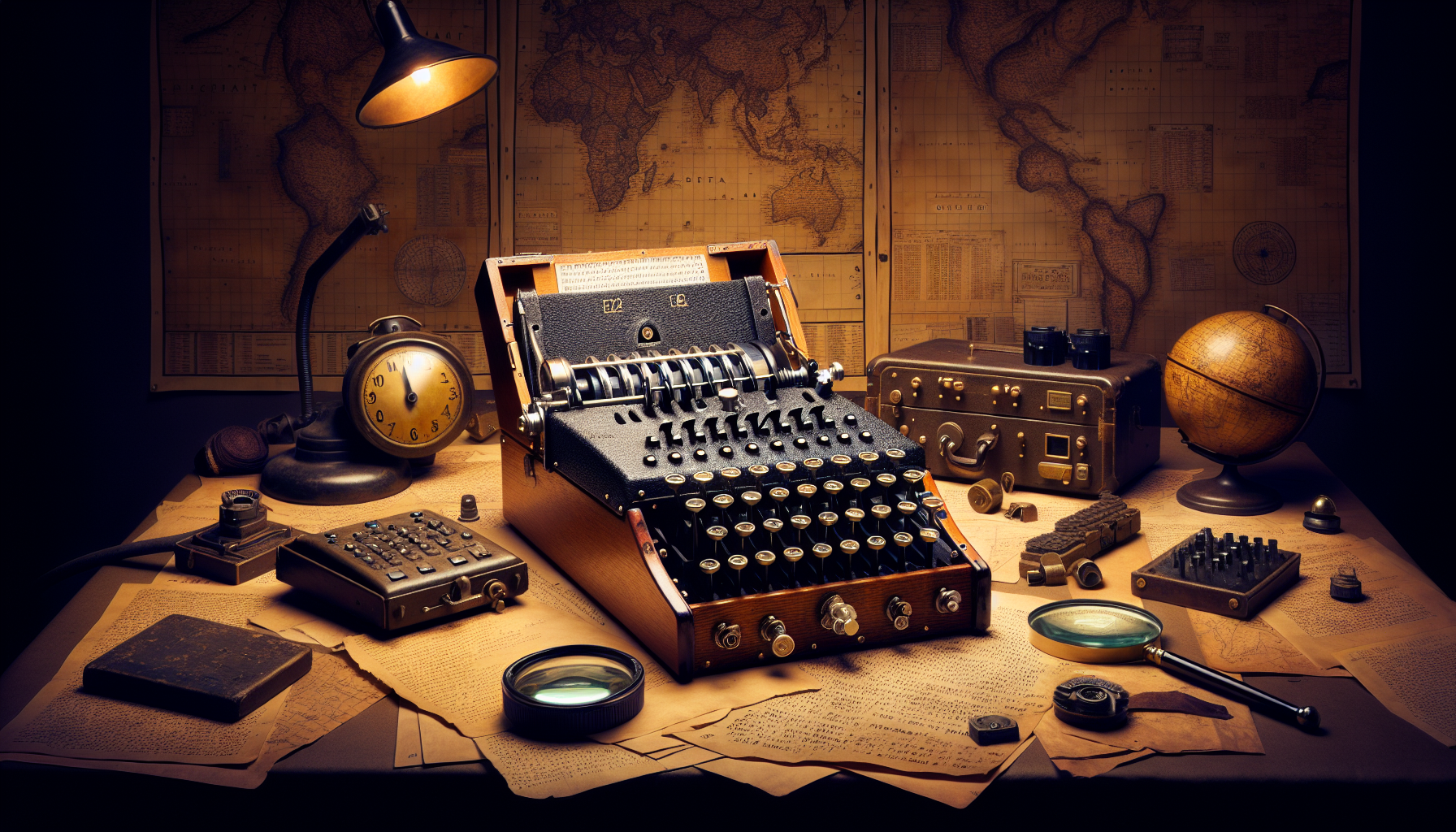
At its core, the Enigma machine consists of rotors, a plugboard, and a lamp board, working in harmony to produce a seemingly impenetrable cipher. It operates on a simple principle—each keypress results in a complex scramblings of letters, generating an encoded message that only another Enigma machine with the correct settings could decode. The interaction of rotating rotors, along with the possibility of plugging wires between letters to further obscure the message, created a vast number of possible combinations, rendering the decryption of these messages a daunting task. You can appreciate the Enigma as a mathematical puzzle that cloaked vital information, even while its inherent design flaws would eventually lead to its unraveling.
Evolution of the Enigma in Nazi Germany
As WWII progressed, the Nazi regime continually adapted and refined the Enigma machine, enhancing its complexity in response to the evolving challenges of warfare. New versions incorporated additional rotors and advanced wiring configurations, increasing the number of possible settings exponentially. You might consider how these developments contributed to the machine’s reputation as unbreakable, fostering a false sense of security among its users. The Enigma became a symbol of Nazi technological prowess, even as it ultimately became a focal point for the Allies’ codebreaking efforts.

Initial Codebreaking Efforts
Polish cryptologists and early successes
Before the United Kingdom’s significant codebreaking advancements at Bletchley Park, Polish cryptologists laid the groundwork for deciphering the Enigma machine’s complexities. In the 1930s, a group of brilliant mathematicians, including Marian Rejewski, began to make sense of the Enigma’s operation. Their careful study led to important breakthroughs, allowing them to recover keys and ultimately decode intercepted messages. For you, this part of the story exemplifies how cross-border collaboration and intellectual perseverance can lead to monumental gains in military intelligence.
Contributions of Marian Rejewski and his team
Marian Rejewski, alongside his colleagues Jerzy Różycki and Henryk Zygalski, developed mathematical techniques to exploit the weaknesses of the Enigma machine. Using a method known as “permutation theory,” they devised the first successful method of breaking the cipher. Their perseverance and determination paved the way for further advancements in the field. You should reflect on the intellectual rigor and ethical commitment inherent in their work, as these individuals understood that their contributions could save millions of lives.
Sharing intelligence with the Allies before the war
As Europe descended into chaos, the Polish cryptologists recognized the need to share their findings with their allies. In 1939, just before Poland was invaded, they passed crucial information regarding their breakthroughs with the Enigma to British and French intelligence. This preemptive collaboration significantly set the stage for future successes. You must appreciate this act of camaraderie as a profound example of unity in dire times—countries working together to combat a looming threat, influenced by shared knowledge and mutual survival.
Bletchley Park: The Codebreaking Hub
Establishment of Bletchley Park as a secret base
Bletchley Park, located in Buckinghamshire, England, was hastily transformed into the epicenter of British codebreaking during WWII. As the war intensified, the British government established the Government Code and Cypher School (GC&CS) here, converting a stately home into a clandestine hub of activity. You can visualize this space bustling with energy; mathematicians, linguists, and engineers vigorously working against time to decipher German communications. The secrecy surrounding Bletchley Park underscored the critical nature of the work being conducted, which could not be disclosed to the public until decades later.
Diversity of the team: mathematicians, linguists, and engineers
The success of Bletchley Park rested on the diverse talents of its personnel. The team comprised individuals from varied backgrounds—mathematicians, linguists, chess champions, and engineers—all unified by a singular objective: to decipher the Enigma codes. This diverse skill set enriched the codebreaking efforts, allowing for innovative approaches to problem-solving. For you, this diversity stands as a testament to the notion that complex problems often require multifaceted solutions—bringing together disparate perspectives to achieve a common goal.
Leadership and influence of Alan Turing
Alan Turing, an enigmatic figure in both mathematics and computing, emerged as a central leader at Bletchley Park. His visionary ideas and tireless dedication revolutionized the codebreaking process. Turing’s scientific prowess enabled him to conceptualize and design the Bombe machine, an electromechanical device specifically developed to expedite codebreaking efforts. You may recognize Turing’s story as emblematic of how one individual’s intellect, combined with collaborative effort, can have dramatic implications on history—charted gears of conflict, technology, and ethics intertwining in ways that forever altered the course of human civilization.
The Bombe: Revolutionizing Codebreaking
Concept and design of the Bombe machine
The Bombe was a breakthrough in the field of codebreaking, designed to automate the laborious process of deciphering Enigma-encoded messages. Turing and his colleagues devised a mechanism that could rapidly test different Enigma settings against known ciphertext. Operating through a series of rotating drums, the Bombe exploited weaknesses in the Enigma’s design, speeding up operations that would have previously demanded countless hours of manual work. For you, the invention of the Bombe represents a critical intersection of engineering and mathematics, transforming theoretical concepts into practical solutions that had real-world applications.
How the Bombe tested Enigma settings at speed
The Bombe’s brilliance lay in its capacity to test multiple combinations simultaneously, significantly accelerating the codebreaking process. By arranging potential configurations of rotors and cables, it could determine which settings matched specific ciphertext inputs. Each operation yielded more data, guiding the team towards the correct Enigma settings that would reveal the plaintext. You should consider how this technological advancement not only shifted the dynamics of codebreaking but also marked a significant leap toward the development of modern computer science.
Impact of the Bombe on breaking Enigma codes
By 1940, the Bombe was instrumental in producing significant intelligence known as “Ultra,” offering insights into German military operations. The efficacy of the Bombe often meant that what previously took days or weeks to decipher could now be accomplished in hours. This monumental achievement significantly influenced military operations on multiple fronts, allowing the Allies to stay one step ahead of their enemies. You can recognize the Bombe not merely as a machine but as a powerful tool that changed the very nature of warfare, ushering in a new era of intelligence and strategy.
Ultra: The Intelligence Program
Definition and significance of ‘Ultra’ intelligence
The intelligence emanating from Bletchley Park was codenamed “Ultra,” denoting sensitive and highly classified information acquired through the decoding of enemy communications. Ultra intelligence represented a game-changing advantage for the Allies, providing critical insights into enemy movements, strategies, and vulnerabilities. For you, this encapsulates the power of intelligence—an invisible force driving decisions that could alter the fates of entire nations.
Types of information collected from intercepted signals
The information gleaned from Ultra included detailed reports on troop deployments, operational plans, and the locations of U-boats in the Atlantic. These insights allowed commanders to anticipate enemy actions and make strategically advantageous decisions. You may appreciate how the ethical implications of such intelligence-gathering methods led to debates about the morality of espionage in warfare. The tactical advantages offered by Ultra often came with fraught moral complexities, highlighting the ongoing tension between military imperatives and ethical considerations.
Consequences of Ultra intelligence on military strategy
Ultra intelligence had far-reaching effects on military strategy throughout the war. It played a pivotal role in significant operations, allowing the Allies to outmaneuver Axis forces, disrupt supply lines, and anticipate counterattacks. You can grasp how the intelligence gleaned from decryption contributed to major victories, including the dramatic success of the D-Day landings, while simultaneously reshaping conventional military thought. The benefits derived from Ultra highlighted the strategic importance of intelligence in modern warfare and set the stage for future military doctrines.
Strategic Outcomes Influenced by Codebreaking
Key victories aided by Ultra intelligence
The impact of Ultra intelligence on specific military decisions cannot be overstated. For instance, knowledge gained from decrypted communications allowed the Allies to pinpoint key weaknesses within the Axis’ infrastructure, leading to decisive victories in key battles. The ability to preemptively strike and adapt strategies based on accurate information was instrumental in turning the tide of war. You may realize how these victories underscore the profound responsibilities that accompany intelligence operations, ensuring that the fruits of such knowledge are wielded with care and consideration.
Impact on D-Day and the Normandy landings
One of the most notable examples of Ultra’s influence can be seen in the planning and execution of the D-Day invasion on June 6, 1944. Decrypted messages provided insights into German troop movements, allowing Allied commanders to adopt strategies that maximized their chances of success. The knowledge that the Germans were unprepared for an invasion at a specific location paved the way for a successful landing, ultimately marking a crucial turning point in the war. You might see this as a testament to how intelligence profoundly influenced decisive moments in history, altering the course of events and shaping the future.
Role in the Battle of the Atlantic
During the Battle of the Atlantic, Ultra intelligence became paramount in countering the relentless threat posed by German U-boats. The ability to intercept and decode communications regarding U-boat positions and movements enabled the Allies to better safeguard their convoys, disrupting the Axis supply chains. You may appreciate this role as a demonstration of how intelligence efforts can transform the outcomes of prolonged engagements, shaped by a relentless pursuit of strategic advantage amidst the chaos of wartime uncertainty.
Personal Stories of Codebreakers
Joan Clarke’s contributions and challenges
Among the prominent figures at Bletchley Park was Joan Clarke, a brilliant mathematician whose contributions greatly impacted codebreaking efforts. Clarke worked alongside Turing and played an essential role in developing algorithms for the Bombe. However, her experiences also reflect the gender biases of the era, which posed significant challenges to her professional recognition and career advancement. For you, her story is one of remarkable resilience, illustrating how potential can thrive even amidst systemic obstacles, reminding you that brilliance is not constrained by societal norms.
Gordon Welchman’s role and innovations
Gordon Welchman was another pivotal figure in the Bletchley Park team, responsible for significant innovations that advanced the efficiency of codebreaking processes. His development of the “diagonal board” helped organize potential solutions generated by the Bombe, maximizing the chances of successfully deciphering messages. You can see Welchman’s contributions as a crucial element of a collaborative effort, highlighting how collective problem-solving and innovative thinking can lead to monumental breakthroughs, especially in times of crisis.
The human cost and personal sacrifices faced by codebreakers
Despite their remarkable achievements, life at Bletchley Park was not devoid of hardship. The intense pressure to break codes and produce timely intelligence took a toll on many codebreakers. Individuals worked long hours under strict secrecy, sacrificing their personal lives and mental health for the war effort. You might ponder the ethical dimensions of their work, noting that though their efforts were celebrated post-war, they often faced profound personal challenges and trauma that would not be fully acknowledged until much later.
The Secrecy and Legacy of Bletchley Park
Secrecy surrounding codebreaking efforts during and after the war
The work conducted at Bletchley Park remained shrouded in secrecy; even after the war, codebreakers were sworn to silence about their contributions. This lack of recognition troubled many former operatives who felt their efforts were overlooked. You may find this dynamic thought-provoking, as it raises questions about the nature of heroism in conflict, the ethics of information secrecy, and the impact of historical narratives shaped by selective memory.
Post-war silence and honors received years later
It was not until decades after WWII that the contributions of Bletchley Park’s codebreakers began to receive due recognition. The declassification of documents and the gradual acknowledgment of their achievements in popular culture have restored their narratives to the forefront of history. You might reflect on this delayed honor as a reminder of the complex relationships between society, history, and memory—an illustration of how truths can remain hidden, waiting for the tide of time to reveal them.
The impact of the codebreakers’ work on future cybersecurity
The legacy of Bletchley Park extends beyond its wartime accomplishments, having laid the groundwork for modern computational theory, cryptography, and cybersecurity. The methods developed by Turing and his colleagues resonate through today’s technological frameworks, shaping how we understand and secure information in an increasingly digital landscape. You can appreciate this evolution as a profound legacy—one that illustrates the far-reaching implications of intelligence work and the ways in which historical narratives can inform contemporary challenges in safeguarding information.
Conclusion: The Enduring Impact of Codebreaking in WWII
Summation of the codebreakers’ achievements
The achievements of WWII codebreakers stand as a testament to the ingenuity, resilience, and collaborative spirit of individuals in the face of monumental challenges. Through their efforts, they not only secured critical intelligence that influenced the outcome of the war but also laid the foundation for the field of computing and modern encryption. For you, their accomplishments reflect the intersection of intellect and dedication, offering a poignant reminder of the human capacity for innovation amidst adversity.
Reflection on the moral implications of their work
As you reflect on the legacy of Bletchley Park, the moral implications of their work come into focus. The codebreakers’ contributions raise complex questions about the ethics of warfare, the role of intelligence, and the human cost of conflict. You can recognize that while their work ultimately aimed to preserve freedom and protect lives, it also highlighted the inherent tensions between victory and the ethical responsibilities that accompany such achievements.
The relevance of their legacy in today’s technological landscape
The codebreakers of WWII remind you that the battle for information security is an ongoing struggle, relevant to contemporary global conflicts and societal issues. Their legacy persists in our current approaches to cybersecurity, encryption, and information management. As you navigate today’s digital world, you may come to see the complexities of privacy, security, and ethical considerations as reflections of the very challenges faced by those who deciphered the Enigma codes—an echo of history shaping our present and future.