
The Boxer Rebellion, occurring between 1899 and 1901, represents a significant moment in Chinese history marked by a fervent anti-foreign uprising intertwined with a surge of nationalistic sentiment. Local fighters, driven by a desire to reclaim sovereignty, confronted an imposing coalition of foreign powers, leading to pivotal events such as the siege of the legations in Beijing. This confrontation ultimately highlighted the clash between rising Chinese nationalism and the entrenched interests of imperialist nations, causing profound ramifications for China’s future.
The aftermath of the rebellion brought about the Boxer Protocol of 1901, which imposed severe consequences on the Qing dynasty, including foreign troop presence in Beijing and a mandate for extensive reforms. Although the uprising did not successfully eliminate foreign domination, it catalyzed a wave of domestic changes and invigorated a sense of nationalism that would resonate throughout the 20th century. This article will examine the motivations behind the rebellion, key developments during the conflict, and the lasting impact on China and the international landscape.
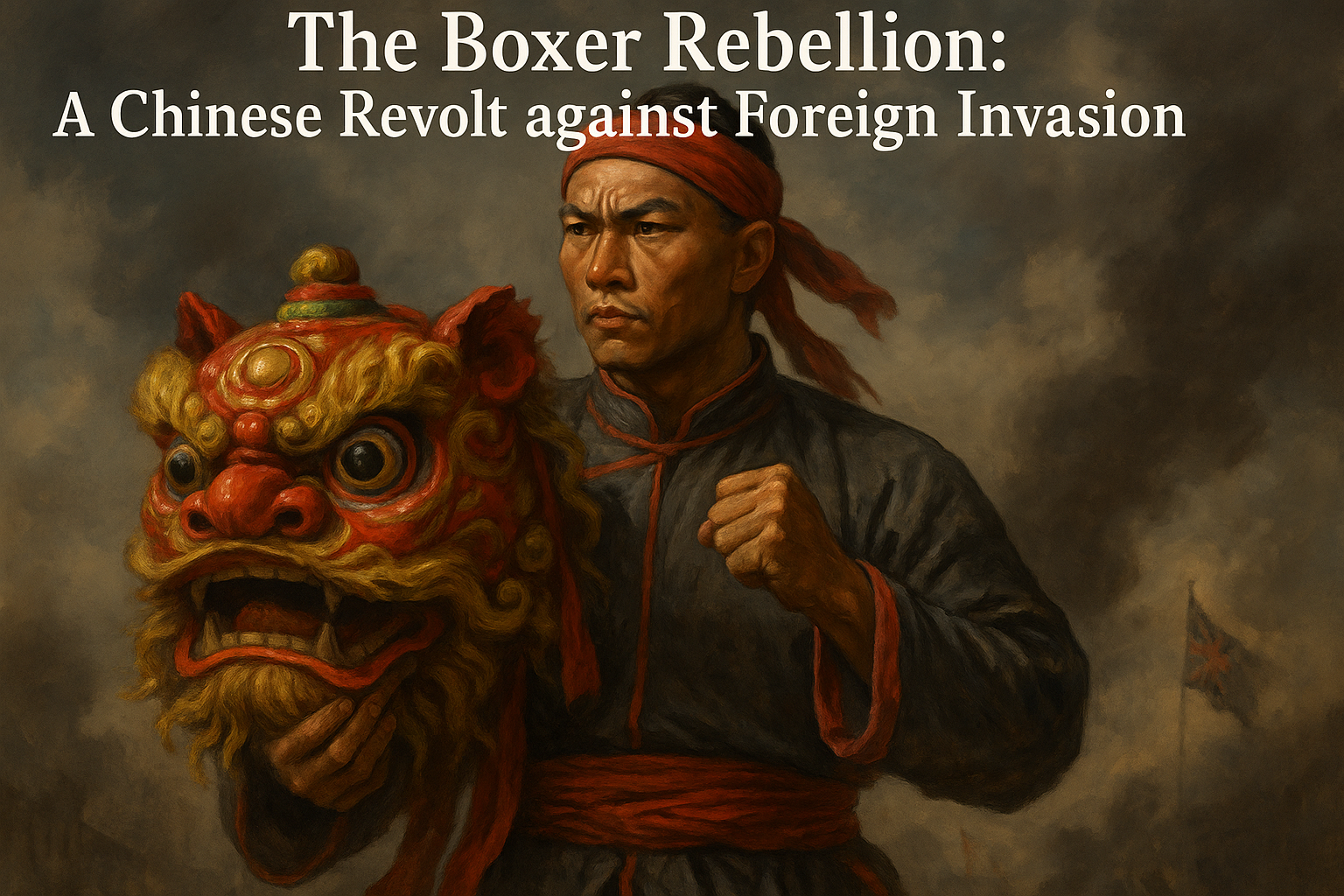
The Boxer Rebellion: A Chinese Revolt against Foreign Invasion
Background of the Boxer Rebellion
Historical context of late Qing China
The late Qing Dynasty (1644–1912) marked a tumultuous period in Chinese history, characterized by internal strife and the encroachment of foreign powers. As you delve into this era, you’ll notice that the Qing rulers were struggling to maintain control over a vast and diverse empire. The Taiping Rebellion (1850–1864), one of the deadliest conflicts in history, had weakened the state. Furthermore, the sense of decay in moral and governing authority contributed to widespread dissatisfaction among the populace. An examination of this historical context reveals a nation on the brink, with the Qing court unable to cope with either internal rebellions or external pressures.
Foreign influences in China
As foreign powers began to assert their dominance, China found itself increasingly vulnerable to external control. Opium Wars (1839–1842, 1856–1860) catalyzed this dynamic, opening Chinese ports to trade and ceding territory, including Hong Kong. Such humiliating defeats not only eroded China’s sovereignty but also disillusioned the populace with the Qing leadership’s ability to protect national interests. Moreover, the influx of Western ideas and technologies led to cultural clashes and cultivated an atmosphere ripe for anti-foreign sentiment. As you consider this influence, remember that the Boxer Rebellion was not merely a reaction against foreign intrusion but also a clash of ideologies that would come to define Chinese identity.
Socio-economic challenges faced by the Chinese populace
The socio-economic landscape of late Qing China was marked by dire challenges. A population boom, compounded by natural disasters and the inadequacies of the Qing governing system, led to widespread poverty and food insecurity. Rural areas were particularly hard-hit, as agrarian economies faltered under the weight of tax burdens and corruption. The plight of the peasantry became a driving force behind the Boxers, who viewed foreign powers and Christian missionaries as exploitative agents undermining traditional Chinese values and social structures. Thus, as you analyze these socio-economic challenges, remember that they cultivated the very soil from which the seeds of rebellion would grow.
The Ideological Roots
Anti-foreign sentiment in China
The Boxer Rebellion emerged from a deeply ingrained anti-foreign sentiment that pervaded late Qing society. The presence of foreign missionaries and their perceived conversion efforts exacerbated feelings of resentment among traditionalists who saw these endeavors as a direct threat to Confucian values and social harmony. This sentiment crystallized into a movement that espoused the idea of “supporting the Qing and destroying the foreigners” (Zhongaoyou jia) as an affirmation of indigenous culture and national identity. As you reflect on these anti-foreign sentiments, consider their implications for collective action—this was not just a passive resentment, but an active, organized response to perceived injustices.
The rise of Chinese nationalism
The Boxer Rebellion can also be seen as part of the larger narrative of rising Chinese nationalism. The notion of a unified Chinese identity transcended regional and ethnic divisions, fueled by resentment towards imperialist encroachment. Nationalist ideas began to permeate through intellectual circles, advocating for reforms and modernization alongside a return to traditional Chinese values. The Boxers’ quest for a “pure China” sought to reconcile these tensions, calling upon people’s patriotic duty to reject foreign control. In such a climate of emergent nationalism, the rebellion symbolizes both hope and despair—an aspiration for collective identity that battled against the empire’s own disintegration.
Spiritual beliefs and their influence on the Boxers
The spiritual beliefs central to the Boxers’ ideology played a pivotal role in motivating action during the rebellion. Rooted in traditional folk religion, these beliefs emphasized the power of spiritual rituals and practices to invoke protection against foreign forces. The Boxers believed that through vigorous physical training and spiritual rituals, they could render themselves invulnerable to bullets and achieve miraculous feats. This profound faith in spiritual empowerment became a mobilizing force that galvanized support for the movement, providing adherents with a sense of purpose and cohesion amid the chaos. Hence, as you explore this ideological facet, recognize that the Boxer Rebellion was steeped not only in politics and nationalism but also in the spiritual quest for agency.

Key Players in the Rebellion
The Boxers: Who were they?
The Boxers, formally known as the “Yihequan” (Righteous and Harmonious Fists), consisted primarily of economically disadvantaged peasants who were driven by a palpable sense of injustice. They were a heterogeneous group, encompassing not just rural laborers but also some artisans and craftsmen who shared similar grievances against foreign exploitation and local corruption. As you investigate their background, it is essential to understand the charisma of their leaders and the community’s collective memory of past struggles. The Boxers represented the marginalized sectors of society, tapping into long-standing grievances against both the Qing Dynasty and foreign intruders.
The Qing Court’s role and its internal conflicts
The Qing court’s response to the Boxer Rebellion was marked by indecision and internal conflict. While some officials sympathized with the Boxers’ grievances, others viewed them as a threat to dynastic stability. Empress Dowager Cixi’s initial ambivalence eventually shifted towards support for the Boxers as a desperate attempt to rally popular support against foreign powers. This internal conflict reflected broader questions about loyalty and authority within the monarchy, as the Qing struggled to navigate the dichotomy between reform and tradition. In this light, you can see how the Qing Dynasty found itself trapped between appeasing its populace and managing foreign relations, ultimately leading it towards a fatal miscalculation.
Foreign powers involved and their interests
The Boxer Rebellion attracted the attention of various foreign powers whose interests lay in preserving their privileges in China. The Eight-Nation Alliance, consisting of Britain, France, Germany, Austria-Hungary, Italy, Japan, Russia, and the United States, formed to protect their nationals and property, as well as reassert their influence over the weakening Qing Dynasty. Each nation had its own motivations—ranging from territorial expansion to missionary work—leading to a complex mix of geopolitical interests that would shape the conflict. As you reflect on these dynamics, you should consider how the interests of these powers intersected with the Boxers’ aspirations, ultimately intensifying the cycle of violence and resistance.
Timeline of Events
Initial uprisings and their triggers
The Boxer Rebellion did not emerge spontaneously; it was preceded by a series of smaller uprisings rooted in anti-foreign sentiment. In 1898, the Boxers first gained significant traction in Shandong Province, targeting Christians and foreign missionaries in response to escalating grievances. The foreign presence continued to provoke localized resistance, and by 1899, a series of violent confrontations culminated in a broader rebellion. Each trigger—from a drought affected by foreign exploitation to a perceived inability of the Qing government to protect its citizens—lowered the threshold for collective action among the Boxers, pressing them into a larger, organized revolt.
The siege of the legations in Beijing
The siege of the legations in Beijing, which began on June 20, 1900, became a defining moment of the Boxer Rebellion. Foreign nationals sought refuge in the numerous legations (diplomatic missions) that dotted the landscape, fortified against the encroaching Boxers. This siege symbolized both the grit of foreign resistance and the fervor of Chinese nationalism, as the Boxers were emboldened by their belief in spiritual invincibility. For 55 days, the siege unfolded amidst harrowing conditions, with the foreign legations holding out despite being outnumbered and besieged. As you analyze this critical event, consider how it crystallized international tensions and deepened the rift between Chinese aspiration for sovereignty and foreign intervention.
Key battles and turning points in the Rebellion
The Boxer Rebellion was punctuated by several key battles and events that changed the course of the conflict. Prominent among these was the relief expedition led by the Eight-Nation Alliance, which aimed to break the siege and secure control over Beijing. The capture of the city in August 1900 marked a significant turning point, firmly establishing foreign dominance in the region. One must also acknowledge the waning support for the Boxers leading up to this moment, as the internal divisions among them became apparent. The battles fought during this period would not only catalyze the decline of the Boxer movement but also reinforce foreign influence in China, illustrating how military engagement was intertwined with broader socio-political realities.
The Eight-Nation Alliance
Formation of the alliance
The Eight-Nation Alliance was formed in response to the growing threat posed by the Boxer Rebellion, as foreign powers sought to protect their interests in China. The alliance included Britain, France, Germany, Austria-Hungary, Italy, Japan, Russia, and the United States, each nation motivated by a combination of geopolitical aspirations and commercial interests. The foundation for this coalition was laid in early 1900, as discussions about mutual defense escalated into a concerted military effort. As you reflect on the formation of the alliance, consider how it represented both a unified front against perceived barbarism and a paradox of imperialism that further exacerbated China’s plight.
Military strategies employed by the alliance
The military strategies employed by the Eight-Nation Alliance demonstrated a blend of force, diplomacy, and command of technological superiority. Their unified armies advanced through northern China using superior weaponry, logistics, and tactics, while engaging in brutal suppression of Boxer resistance. Furthermore, the alliance also relied on psychological tactics, emphasizing their relative power in the face of traditional Chinese valor. International cooperation among the alliance members allowed for a coordinated approach that overwhelmed the fragmented Boxer efforts, making their military strategy effective yet emblematic of colonial oppression. As you analyze these military strategies, think critically about the implications of collective foreign intervention on local dynamics and the longer-term consequences it imposed on national sovereignty.
Key battles against the Boxers
The conflict witnessed several key battles between the Eight-Nation Alliance and Boxer forces that significantly shaped the outcome of the rebellion. Notable confrontations included the Battle of Tientsin in June 1900 and the subsequent March on Beijing, where alliance forces faced fierce resistance from the Boxers. Despite this, the superior firepower and military tactics of the alliance gradually subdued Boxer forces, demonstrating the vast disparities in military capability between the local insurgents and the coalition. These key battles not only signified a turning point in the military landscape but also exposed the vulnerabilities of the Qing Dynasty as they struggled to mitigate external incursions and internal dissent.
The Siege of the Legations
Conditions leading to the siege
In the weeks leading up to the siege of the legations, tensions had escalated to a boiling point. Anti-foreign sentiment erupted into violence as the Boxers sought to eradicate all foreign influences in China. A series of skirmishes, attacks on Christian missionaries, and the targeting of Chinese converts made the situation critical. As chaos consumed Beijing, foreign diplomats and nationals took refuge in the legations, forming a microcosm of international interests amidst the brewing storm. The conditions within the legations reflected a microcosm of the broader conflict—a standoff that exemplified the profound cultural and ideological chasm that divided the Chinese populace from foreign influences.
Duration and experiences within the legations
The siege lasted from June 20 to August 14, 1900, with those ensconced in the legations facing dire conditions. Supplies dwindled, and morale fluctuated as the defenders struggled to maintain a unified front. Daily bombardments and increasingly desperate attempts to breach the defenses by the Boxers created a harrowing atmosphere. Despite the threat, a spirit of camaraderie emerged among the besieged, exemplified by collective rituals and diplomatic endeavors to communicate with the outside world for assistance. As you contemplate the experiences within the legations, it becomes evident that this act of resistance would come to symbolize foreign defiance against perceived barbarism and the fragility of imperial power.
International responses and the aftermath of the siege
The siege culminated in a significant international military response, with the Eight-Nation Alliance launching a coordinated rescue operation that successfully relieved the legation on August 14, 1900. The aftermath of the siege further solidified foreign control in Beijing and spurred the imposition of the Boxer Protocol, which included reparations and territorial concessions. Internationally, the event galvanized support among various nations for a more assertive posture in China, fortifying a colonial mindset that would permeate through the early 20th century. Hence, as you consider the international responses, reflect on how the aftermath of the siege entailed not only territorial gains but also a reconfiguration of power dynamics within China that would persist long after the Rebellion.
Consequences of the Rebellion
The Boxer Protocol of 1901
The Boxer Rebellion culminated in the infamous Boxer Protocol, signed in September 1901. This agreement imposed severe penalties on the Qing Dynasty, including substantial financial indemnities, restrictions on troop movements, and the execution of government officials perceived to have supported the Boxers. The protocol effectively secured foreign influence in Chinese governance, as foreign troops would be stationed in Beijing to ensure compliance with the treaty’s stipulations. For you, understanding the Boxer Protocol is critical, as it illustrates the ramifications of international conflict while simultaneously bearing witness to the internal struggles of a nation grappling with colonial domination.
Indemnities and foreign influence in China
The financial indemnities imposed by the Boxer Protocol had substantial repercussions for China, crippling its economy and deepening resentment among the populace. As you analyze these financial burdens, consider how they served to, on one hand, reinforce foreign control and, on the other, plant the seeds of further nationalistic sentiments amongst Chinese intellectuals and reformers. This foreign influence manifested through direct interventions in Chinese governance and the introduction of various reforms that sought to modernize the nation, ultimately leading to a transformation of Qing policies and society at large.
Impact on Qing Dynasty and subsequent reforms
The Boxer Rebellion and its aftermath hastened the decline of the Qing Dynasty, exposing its vulnerabilities against both foreign powers and domestic discontent. In response to the rising tide of nationalism and desperation among the populace, the Qing attempted various reforms aimed at strengthening the state. However, these reform efforts were often half-hearted and met with resistance from conservative factions within the court. While the Boxer Rebellion ultimately decimated the power of the Qing, it also laid the groundwork for subsequent revolutionary movements, underscoring an era of transformation within China. Thus, in reflecting upon this impact, you should appreciate how the Rebellion served as a catalyst for both reform attempts and the eventual rise of more radical factions.
The Boxer Rebellion’s Legacy
Rise of Chinese nationalism
The Boxer Rebellion left an indelible mark on Chinese nationalism, as it exposed the frailty of foreign power and galvanized sentiments of national pride and unity. Though the rebellion itself was quashed, the ideals it represented contributed to a burgeoning sense of national identity that would fuel future uprisings. As you contemplate this legacy, recognize that despite its failure, the Boxer Rebellion represented a crucial moment in the struggle for national self-determination, nurturing a spirit of resistance that would resonate through the 20th century.
Influence on subsequent revolutions and movements
The Boxer Rebellion foreshadowed a series of revolutionary movements that would arise in China, culminating in events like the 1911 Xinhai Revolution, which abolished the Qing Dynasty. The ideas and sentiments garnered during the Boxers’ uprising inspired intellectuals and activists who sought to dismantle imperial rule and establish a modern, republican state. As you examine the influences on these subsequent movements, consider how the legacy of the Boxer Rebellion would remain prominently embedded within the fabric of modern Chinese history, shaping the trajectory of political resistance and reform.
Long-term effects on Sino-Western relations
The Boxer Rebellion also had lasting implications for Sino-Western relations, intensifying mutual distrust that would resonate across generations. As the Boxer Protocol etched foreign power into the very governance of China, diplomatic ties were strained and fraught with complexity. This historical moment would come to shape broader themes of cultural encounter, imperialism, and resistance in the relationship between China and the West. So, in reflecting on these long-term effects, you should acknowledge how the Boxer Rebellion not only altered the landscape of Sino-Western relations but also contributed to a conceptual framework of resistance against hegemonic forces.
Historical Interpretation
Different perspectives on the rebellion
Historians have often interpreted the Boxer Rebellion through various lenses, from viewing it solely as a nationalistic uprising to understanding it as a complex interplay between traditionalism and modernity. Some see it as a desperate attempt to defend traditional Chinese society against foreign encroachment, while others perceive it as a manifestation of foreign manipulation exploiting local grievances. These differing perspectives open a rich dialogue around the motivations, processes, and significance of the Rebellion, inviting you to engage critically with these interpretations and consider the multifaceted nature of historical events.
Historiographical debates surrounding the Boxer Rebellion
The historiography of the Boxer Rebellion has evolved over time, encompassing debates around agency, representation, and the legacy of colonialism. Scholars have examined the role of the Qing government and the perspectives of marginalized Chinese participants, leading to ongoing discussions about legitimacy, victimization, and resistance. As you navigate these historiographical debates, consider the implications of how historical narratives are constructed—what voices are amplified, and what legacies are cultivated through divergent interpretations?
How the rebellion is portrayed in modern Chinese narratives
In modern Chinese narratives, the Boxer Rebellion is often framed within the context of historical memory, nationalism, and statecraft. The rebellion is portrayed not merely as a violent uprising but as a culturally significant moment reflecting collective resistance to foreign aggression. Contemporary discourse frequently invokes the legacy of the Boxers as a source of inspiration for ongoing struggles for sovereignty and dignity in the face of international tensions. As you analyze these modern portrayals, you will observe how history continues to inform contemporary identity and actions.
Conclusion
Summary of the Boxer Rebellion’s impact on China
The Boxer Rebellion stands as a pivotal episode in Chinese history, illustrating the clash between indigenous aspirations and foreign imperialism. While the immediate outcomes of the rebellion favored foreign powers, the longer-term effects fostered a spirit of nationalism and a burgeoning desire for reform that would shape China’s trajectory well into the 20th century. The social, political, and economic consequences of this rebellion reverberated through Chinese society, leaving scars that would challenge subsequent generations.
Reflection on the significance of the rebellion in history
Reflecting upon the significance of the Boxer Rebellion, one must recognize its dual role in affirming indigenous resistance and generating tumultuous shifts within the Qing Dynasty. This rebellion encapsulates the complexity of late imperial struggles, where notions of identity, agency, and national sovereignty converge. As such, it serves as a reminder that the past continues to mold the consciousness of societies as they grapple with their identities amid external pressures.
The continuing relevance of the Boxer Rebellion in modern discourse
In modern discourse, the Boxer Rebellion remains a salient touchstone for discussions around imperialism, nationalism, and cultural identity. It invites ongoing inquiry into the dynamics of power, colonial legacies, and the resilience of cultural identities. This historical episode urges you to consider how societies negotiate their pasts while wrestling with present dilemmas in an interconnected world. Ultimately, the Boxer Rebellion offers profound insights into the nature of resistance, the search for identity, and the quest for sovereignty in the face of overwhelming odds.