
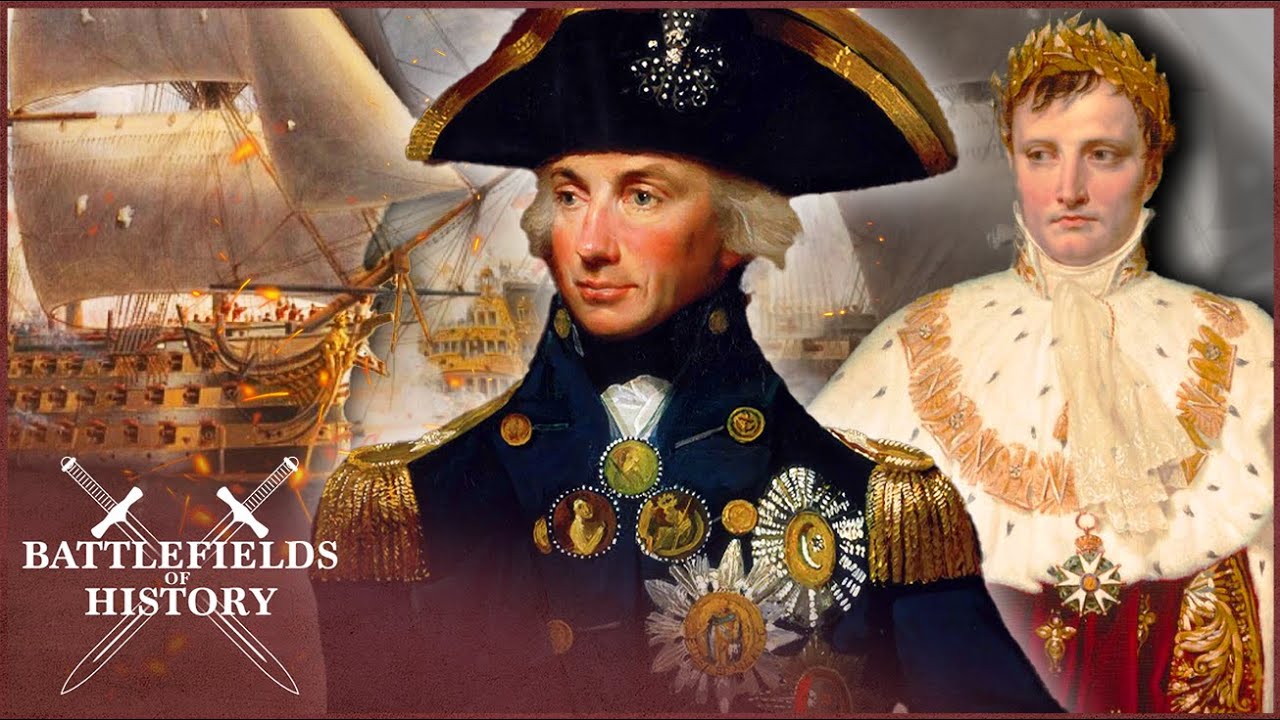
In “Admiral Nelson: The Man Who Defied Napoleon | Nelson’s Trafalgar,” the article explores the life and legacy of Admiral Horatio Nelson, focusing on his pivotal role in the Battle of Trafalgar. The narrative highlights Nelson’s physical injuries sustained during the battle, his unyielding heroism, and the broader context of the Napoleonic Wars, particularly Napoleon Bonaparte’s ambition to conquer Britain. Additionally, it examines the personal challenges Nelson faced, including illness and anxiety, as well as his innovative naval tactics and the influence of his romantic relationship with Emma Hamilton on both his personal and professional life.
You will discover how Nelson’s strategic brilliance and decisive actions changed the course of British history, especially regarding naval warfare. The discussion culminates in Nelson’s tragic death and the resulting national mourning, demonstrating how his legacy continues to resonate in British culture. Through this exploration, you will gain a deeper understanding of the complexities of Nelson’s character and the monumental impact he had on the course of history.
Admiral Nelson’s Background
Early Life and Career
Admiral Horatio Nelson was born on September 29, 1758, in Burnham Thorpe, a small village in Norfolk, England. As the son of a clergyman, you might find his humble beginnings somewhat surprising given his later fame. From a young age, he exhibited a fierce spirit and an undeniable curiosity about the world. At the mere age of 12, you would find him embarking on a journey that would shape his future—joined the British Royal Navy under the command of Captain Maurice Suckling, his maternal uncle. His first experiences at sea introduced you to the rigors of naval life and the burgeoning conflicts of the era, laying the foundation for a career that would elevate him to one of Britain’s most revered naval commanders.
As a young midshipman, Nelson was exposed to the harsh realities of maritime warfare, notably during the American Revolutionary War. By the time he was 20, his innate talent for seamanship and leadership began to surface. You would note how he quickly made a name for himself through his diligence and tenacity, which caught the attention of senior officers. His first significant deployment was to the Caribbean, where he honed his skills further and began to earn accolades for his performance.
Rise through Naval Ranks
Through a combination of sheer determination and opportunistic skill, you would observe Nelson’s steady ascent through the ranks of the Royal Navy. By 1793, during the onset of the French Revolutionary Wars, he held the rank of captain, commanding ships like HMS Agamemnon. Your sense of intrigue would deepen as you learn how he adeptly used naval engagements to distinguish himself from his peers. His innovative tactics and aggressive strategies were particularly evident during the capture of the French West Indies and his commanding role in the Battle of the Nile in 1798.
In the years that followed, events proved pivotal in shaping Nelson’s reputation. Commanders became enamored with his blend of audacity and tactical ingenuity, culminating in promotions that placed him at the forefront of British naval power. By the time he was appointed Vice Admiral of the Nile in 1803, Nelson’s legacy as a strategic thinker in maritime warfare began to solidify. You can easily recognize how his triumphs ignited a sense of pride in the British public and how his leadership style, which often emphasized hands-on involvement and personal bravery, endeared him to his crew.
First Encounters with Battle
You would be compelled to explore Nelson’s initial encounters with battle, which served as the crucible for his eventual mastery of naval warfare. His first significant engagement was the Siege of Fort San Juan in 1779 during the American Revolutionary War. Despite suffering significant setbacks, including being wounded, these experiences would contribute to the resilience and tactical mindset that defined Nelson’s later victories.
In the subsequent years, his reputation was further intensified during the Battle of Cape St. Vincent in 1797. Leading a daring boarding action, Nelson captured the San José and San Nicolás, two Spanish ships, demonstrating his predilection for bold maneuvers. You would appreciate how these early battles instilled in him a profound understanding of enemy strategies and the complexities of naval engagements, traits that would serve him well in his illustrious later campaigns.
The Context of War
Napoleon’s Ambitions
By the early 19th century, the sociopolitical landscape of Europe had transformed dramatically, largely due to Napoleon Bonaparte’s rise as a formidable military leader. You may find it compelling to understand that Napoleon sought to expand French influence and sought to conquer Europe, with Britain as his avowed enemy. His ambitions included asserting dominance over the English Channel, the maritime lifeline of Britain. The audacity of his plans, aiming to invade and usurp British sovereignty, created a palpable sense of urgency both in London and among British naval commanders, including Nelson.
The Significance of Naval Power
In this period, naval power emerged as a critical determinant of national strength. Control of the seas became synonymous with control of trade routes, resources, and the ability to project military force. You would recognize that for Britain, a nation heavily reliant on maritime commerce, the Royal Navy represented its first line of defense against continental adversaries. Understanding the centrality of naval supremacy in warfare, you would grasp how the British public placed their hopes in Nelson as the quintessential leader capable of safeguarding their interests against Napoleon’s advancing forces.
The Threat to Britain
Napoleon’s strategic focus in the summer of 1805 revolved around neutralizing British naval power to open the English Channel for his invasion plans. You would discern the heightened stakes; the specter of a French invasion loomed large, sparking a mix of fear and outrage among the British populace. With his campaign now visible, Napoleon’s ambition became a rallying point for the British ignored the undeniable toll it would impose on their lands should he succeed. This atmosphere of tension and anticipation underscored Nelson’s imperative to engage the burgeoning French fleet decisively.
Nelson’s Tactical Innovations
Strategies Prior to Trafalgar
Before Trafalgar, Nelson developed a series of innovative strategies that would influence naval warfare for generations. You would notice how his experiences at the Battle of the Nile illustrated a revolutionary approach to naval engagement—concentrating firepower through close-range attacks rather than traditional line tactics. This readiness to adapt and innovate established him as a game-changer within the Royal Navy, garnering him both admiration and apprehension.
Innovative Battle Tactics
Nelson’s tactical innovations were characterized by unorthodox formations and aggressive maneuvers aimed at dividing and destroying enemy fleets. For instance, his audacity during the Battle of the Nile involved employing a more direct approach that bypassed conventional line formations. Instead, he executed a bold “crossing the T” strategy, allowing his ships to fire devastating broadsides against the enemy, emerging victorious. This strategic paradigm shift emphasized Nelson’s ability to anticipate enemy movements and capitalize on perceived weaknesses.
Division of the Enemy Fleet
One of the defining concepts of Nelson’s approach involved the division of enemy fleets during combat. You would recognize that his plan for the Battle of Trafalgar hinged upon the principle of breaking the enemy’s formation to prevent cohesive action. By directing his fleet to approach the Franco-Spanish armada perpendicularly, Nelson aimed to sow confusion and dissension among their ranks. This radical approach not only exemplified Nelson’s daring nature but also set the stage for a naval engagement that would become legendary.
The Battle of Trafalgar
Overview of the Battle
The Battle of Trafalgar, fought on October 21, 1805, stands as one of the most significant naval engagements in history. You would appreciate how it involved over 30 British vessels pitted against a combined fleet of approximately 33 French and Spanish ships. Situated off the coast of Cape Trafalgar, the battle unfolded amidst turbulent seas and served as the culmination of Nelson’s relentless pursuit of naval supremacy. For you, the implications of victory were profound—ensuring that Napoleon’s ambitions of invading Britain would be severely curtailed.
Key Players Involved
During this monumental clash, several notable figures played crucial roles. Of course, at the forefront was Admiral Horatio Nelson, commanding the British fleet with a blend of charisma and tactical brilliance. In contrast, Vice Admiral Pierre-Charles Villeneuve led the French contingent, while Spanish Admiral Federico Gravina commanded the Spanish ships. You would recognize these individuals as central to the battle’s trajectory; their decisions and actions significantly influenced the course of the encounter, amplifying the stakes for both nations.
Tactical Execution and Outcomes
As the battle commenced, you would witness Nelson’s meticulously planned tactics come into action. His directive to engage the enemy in a perpendicular formation proved instrumental in achieving a decisive victory. Positioned aboard HMS Victory, Nelson commanded his fleet’s coordination against the often disordered Franco-Spanish formations. Despite suffering catastrophic injuries, his crew executed his commands effectively, resulting in the near-total destruction of the enemy fleet by day’s end. The outcome was unequivocal: Britain emerged triumphant, fundamentally shifting the dynamics of naval warfare and establishing Nelson as a national hero.
Nelson’s Leadership Style
Leading from the Front
One of the most compelling aspects of Nelson’s leadership was his approach of leading from the front. You cannot help but admire how he not only commanded his fleet from a position of authority but actively participated in the fray alongside his men. This embodiment of bravery resonated deeply with his crew, earning him their unwavering loyalty. In an era where commanders often remained distant from the combat, Nelson’s presence on the deck aligned with his belief that effective leadership required direct involvement and personal sacrifice.
Calculated Risks
Nelson’s ability to gauge when to take calculated risks stands as another hallmark of his leadership style. Armed with an innovative mindset and a keen instinct for opportunity, he dared to place his fleet in situations that many would deem dangerous. His decisions were often met with skepticism but ultimately served to reshape naval engagements. For you, the idea that he could execute daring maneuvers while understanding the potential ramifications reveals a complex figure who balanced audacity with analytical foresight.
Public Perception and Controversies
Despite Nelson’s remarkable successes at sea, your examination would reveal that he was not without controversy. His aggressive tactics and impulsive nature drew both admiration and criticism, leaving a multifaceted legacy. Within the press and public discourse, you would find opinions divided; while many celebrated his victories, others questioned certain aspects of his leadership style, particularly his treatment of subordinates. Nelson’s personal life also influenced public perception, as his romances drew attention, underscoring the intriguing duality of his character—a celebrated hero yet a deeply human individual fraught with complexities.
Personal Challenges Faced by Nelson
Health Issues and Injuries
You might find it striking to learn that amid his triumphs, Admiral Nelson was beset by a range of personal challenges, particularly related to his health. Over the years, he accumulated significant injuries from naval engagements, including notable wounds sustained during the Battle of the Nile. His severe injuries and ongoing health issues would plague him and cultivate an air of vulnerability surrounding his otherwise heroic persona. His battle against deteriorating health was characterized by a range of ailments, including chronic migraines and respiratory problems, which added an additional layer of complexity to his leadership during crucial moments of warfare.

Public and Personal Doubts
Despite being hailed as a national hero, you would uncover that Nelson grappled with bouts of self-doubt. The relentless pressure of commanding the British fleet against formidable foes often led him to question his decisions and abilities, particularly in moments of failure. Amidst significant public expectations, these personal struggles became more pronounced as he sought to meet the aspirations placed upon him. As you reflect on his life, you recognize how the weight of public acclaim can lead to an internal conflict, showcasing the broader narrative of what it means to lead under scrutiny.
Managing Anxiety and Public Image
Further complicating Nelson’s personal journey was his ongoing struggle with anxiety, particularly during uncertain times in the face of Napoleon’s advancing forces. You might find it revealing that in his correspondence with his lover, Lady Emma Hamilton, he often expressed feelings of unease. Despite his public persona as a confident leader, this contrast enlivens a narrative where anxiety and self-doubt formed part of his quotidian experience. His careful management of public image, juxtaposed with personal turmoil, evokes a poignant understanding of the human condition beneath the mantle of heroism.
Nelson’s Romantic Life
Affair with Emma Hamilton
Within the context of his personal life, you cannot overlook the complex relationship between Nelson and Emma Hamilton, a woman who would play a pivotal role in his life. Their love affair, which began around 1798, infused his personal narrative with significant emotional depth. As you explore the intricacies of their connection, it becomes clear that Emma represented both a source of affection and solace for Nelson amid the pressures of his naval career. Their relationship was marked by passionate letters and public adoration, which deeply resonated with the British public.
Impact on Nelson’s Career
The relationship with Hamilton held tangible repercussions for Nelson’s career. You might notice that while Emma provided much-needed emotional support, their liaison also drew scrutiny and criticism, casting shadows on his public image. Some contemporaries regarded their affair as morally questionable, particularly within the conservative social milieu of the time. Nonetheless, their bond symbolized a blend of personal devotion and a yearning for intimacy amid the ache of military life, showing how personal relationships can impact public perception and military endeavors.
Public Reaction to Personal Life
As you delve deeper into the societal dynamics of the era, the public reaction to Nelson’s romantic life reveals a fascinating dichotomy. While many lauded their passionate affair, others cast judgment, reflecting the societal norms of the time. The complexity of their relationship illustrates how public figures navigate personal lives against the expectations imposed by society. You would appreciate how the duality of love and scrutiny comes to life through their story, encapsulating the paradoxes inherent in charismatic leadership.
Final Moments and Death
Wounds Sustained in Battle
The final moments of Admiral Nelson were marked by a ferocious battle and profound sacrifice. During the apex of the Battle of Trafalgar, you would find it tragic yet fitting that Nelson sustained mortal wounds from a musket ball, suffering catastrophic damage to his shoulder, spine, and lungs. This grievous injury took place at a time when he was vigorously engaged in directing his crew and ensuring their success against the enemy. Your understanding of his fate would heighten as you realize how he continued to embrace the spirit of leadership even when facing his own mortality.
Final Commands to His Crew
Even as fate turned against him, Nelson’s indomitable spirit remained unbroken. In the moments after being wounded, he reportedly continued to issue commands to his crew, emphasizing the pivotal essence of his leadership style. You would surely find a sense of poignancy in his final instructions: “England expects that every man will do his duty.” These words not only encapsulated his expectations of courage and resolve from his sailors but also resonated in the annals of British history as a rallying cry that defined the ethos of a generation.
His Last Words and Victory News
In accepting his impending death, you would sense the rich emotional atmosphere surrounding Nelson’s final moments. Surrounded by his loyal crew, he underwent a journey of reflection, gravitating towards his love for country and crew over personal apprehension. Just before he succumbed to his injuries, his thoughts turned to the ultimate outcome of the battle. Upon learning of the British victory, his last words echoed throughout the ship, unveiling unadulterated elation at his country’s triumph. A blend of victory and sacrifice crystallized his legacy as you ponder the resonance of a hero’s final act.
Legacy of Admiral Nelson
Posthumous Honors and Recognition
The death of Admiral Nelson in battle ignited an unparalleled wave of national mourning within Britain. His body was returned for burial in St. Paul’s Cathedral, where a magnificent funeral service acknowledged his contributions to British naval supremacy. You would discover how this tribute reflected the deep affection and respect the British public held for him as a national hero. His posthumous honors include monuments and statues erected throughout the United Kingdom, further engraving his image into the national consciousness.
Symbol of British Naval Power
As years passed, Nelson’s legacy became emblematic of British naval power. His victory at Trafalgar established an era of British maritime dominance that would last for over a century. You would recognize the dichotomy in his role—not just as a military commander but as an enduring symbol of Britain’s ability to navigate conflicts and protect its shores from adversaries. The collective memory of Nelson became intricately woven into the fabric of British identity and served as a testament to the nation’s resolve to defend its sovereignty.
Commemoration and Memorials
Preserving Admiral Nelson’s legacy entailed an enduring commitment to commemoration through various monuments and memorials. Trafalgar Square in London features the iconic Nelson’s Column, standing tall as an homage to his life and achievements. You would appreciate how such memorials invigorated national pride and served as focal points for public gatherings and celebrations of British valor. These enduring tributes reflect a society grappling with its historical narrative as it sought to celebrate one of its most revered figures.
Conclusion
Summary of Nelson’s Impact
In summary, Admiral Horatio Nelson emerged as a pivotal figure whose impact on British naval history cannot be overstated. His strategic brilliance, coupled with a profound ability to inspire his crew, defined an era marked by significant maritime challenges. You would agree that his experiences, victories, and eventual sacrifice serve to exhibit the complexities of leadership and the human condition amidst conflict. His life encapsulates themes of heroism, the weight of duty, and the multifaceted nature of public perception.
Reflection on His Leadership
As you reflect on Nelson’s leadership, it becomes evident that he embodied an amalgamation of brilliance and fallibility. His audacity, willingness to embrace risk, and remarkable tactical innovations set the stage for a naval legacy that would extend far beyond his lifetime. You would also note how his capacity to inspire loyalty amidst adversity invites admiration and respect, qualifying him as one of history’s most influential military figures. Ultimately, Nelson’s leadership challenges you to contemplate the intricate relationship between public persona and private struggles.
Enduring Legacy in History
Admiral Nelson’s legacy is one steeped in grandeur and nostalgia, reverberating through the corridors of history. His embodiment of British naval prowess, combined with romanticized narratives of bravery and sacrifice, paved the way for future generations to celebrate and learn from his contributions. Your understanding of Nelson reveals not just a single man, but a phenomenon that ignited the collective imagination of a nation. His story, marked by triumph and tragedy, endures as a poignant reminder of the human spirit’s resilience and the timeless quest for glory on the sea.