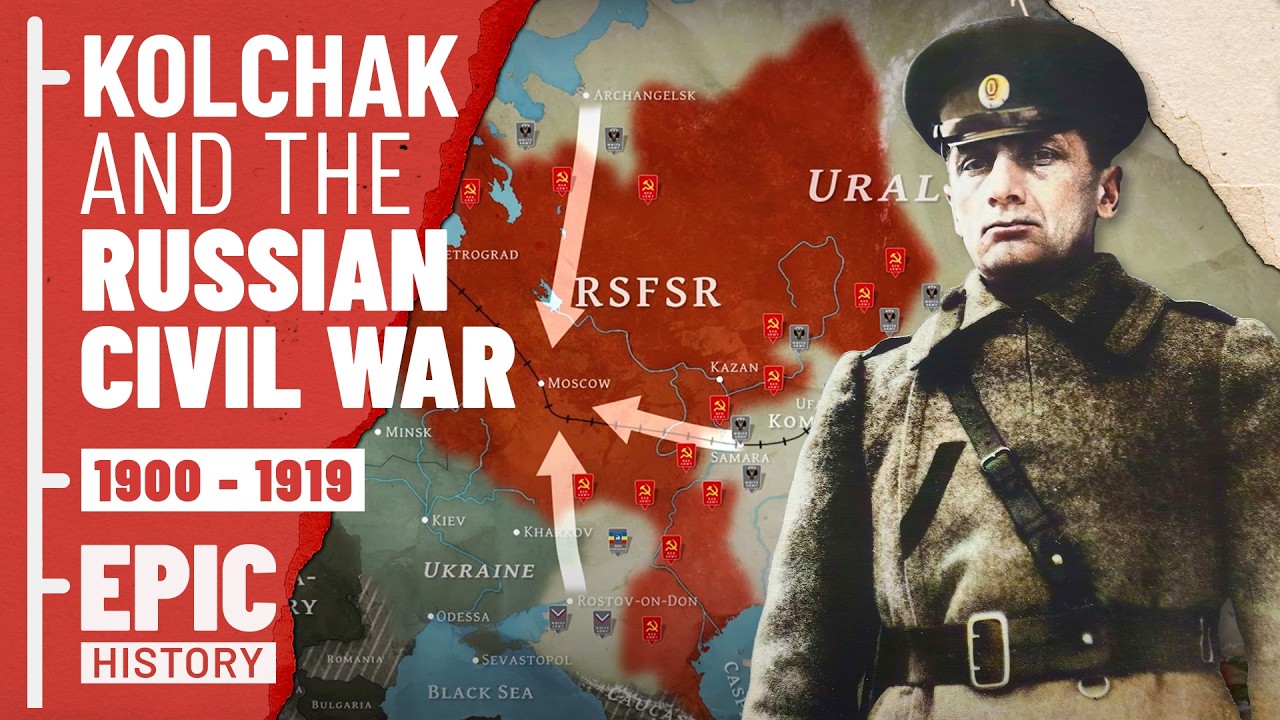
The article provides an analytical examination of Admiral Alexander Kolchak’s significant yet complex role within the tumultuous period of Russia’s Civil War following the Bolshevik Revolution. It outlines how Kolchak, a prominent military leader and devoted patriot, became a prominent figure representing the anti-Bolshevik “White” forces, seeking to restore order and avenge the murdered Tsar amidst widespread chaos. Furthermore, the discussion highlights Kolchak’s earlier military exploits, including his notable experiences in the Russo-Japanese War and World War I, which shaped his leadership style and ambitions.
In assessing Kolchak’s impact on the civil war, the article elucidates the challenges he faced, including securing international support and managing internal dissent within his ranks. As the Supreme Ruler of Russia, his aspiration for recognition and authority was overshadowed by brutal conflict and significant losses. Ultimately, the narrative reveals the duality of Kolchak’s legacy, where some view him as a tragic figure fighting for a lost empire, while others perceive him as emblematic of the oppressive forces during a time of profound societal upheaval.

Historical Context
Overview of Russia’s Civil War
The Russian Civil War erupted in the aftermath of the Bolshevik Revolution in November 1917, generating widespread chaos and conflict throughout the nation. Discontent among various societal groups gave rise to a complex civil strife, wherein the Bolshevik Reds sought to consolidate their power and implement radical socio-economic reforms. Conversely, disparate factions known collectively as the Whites rallied against Bolshevism, each with their ambitions and ideologies. This violent confrontation engulfed the entire former Russian Empire, lasting from 1917 until 1922, and resulting in catastrophic human and material losses—estimates suggest as many as nine million lives were lost during this tumultuous period.
The impact of the Bolshevik Revolution
The Bolshevik Revolution fundamentally altered the course of Russian history by overthrowing the Provisional Government only months after its establishment. This revolution marked the emergence of a government that advocated for class struggle and the dictatorship of the proletariat. The ideologically driven policies of Lenin’s regime aimed to dismantle the previous feudal structures and redistribute land and resources, albeit through violent and authoritarian means. However, these drastic changes alienated broad swathes of the population, including landholders, military officers, and members of a burgeoning, disenfranchised middle class. The apposition to Bolshevism catalyzed the fragmentation of Russian society and served as the catalyst for the civil war.
Significance of Admiral Kolchak’s emergence
Among the central figures against the Bolshevik regime was Admiral Alexander Kolchak, who emerged as a prominent leader of the anti-Bolshevik forces. Known for his naval prowess and wartime heroism, Kolchak was entrusted with the title of “Supreme Ruler of Russia” in November 1918. His rise was significant not only because of his military background but also due to the symbolic nature of his authority, as many in Russian society viewed him as a stabilizing force in a period laden with tumult and uncertainty. Kolchak’s leadership embodied the conservative, monarchist values sought by many who yearned for the restoration of order in the face of revolutionary chaos.
Conflict Overview
The opposing forces: Bolsheviks vs. Whites
The civil war was primarily characterized by the confrontation between the Bolsheviks, representing the Reds, and the Whites, composed of various anti-Bolshevik factions that included liberals, monarchists, and other non-Bolshevik socialists. The Bolsheviks sought the establishment of a socialist state predicated on Marxist principles, whereas the Whites, under Kolchak’s leadership, aimed to restore the pre-revolutionary order. This ideological divide was compounded by local, regional, and national interests, leading to a multi-faceted conflict. The brutality of this war was not just a military affair but also a moral and existential struggle for the vision of a future Russia.
Kolchak’s leadership role among the Whites
Kolchak’s emergence within the White movement was marked by his decisive military strategies and charismatic leadership. His appointment as the Supreme Ruler underscored his capacity to unite disparate factions under a singular command structure, offering a semblance of organized resistance against the Bolsheviks. However, his leadership was also characterized by a military dictator-like approach, which often alienated potential allies and exacerbated internal divisions. As a military leader, his strategies were initially promising yet ultimately fell short as the war progressed.
Goals of the anti-Bolshevik forces
The anti-Bolshevik forces, under Kolchak’s command, sought to restore order and law to Russia, combat Bolshevism, and avenge the death of the executed Tsar Nicholas II. The overarching goal was to re-establish a semblance of the collapsed empire, aiming to unite various factions within Russia under the banner of anti-Bolshevism. Their mission was not only to reclaim lost territories but also to rehabilitate the Russian national identity, which many perceived as jeopardized by the radical policies of the Bolsheviks. This pursuit lay at the heart of Kolchak’s campaign and shaped the military and political landscapes of the conflict.
Kolchak’s Identity
Kolchak as a patriot and military figure
Admiral Alexander Kolchak was revered as a dedicated patriot and distinguished military leader within Russian society. His devotion to “the motherland” permeated both his military conduct and personal ethos. Kolchak’s background as a naval officer ingrained in him a profound sense of duty to protect Russia from perceived threats — both foreign and domestic. This patriotic fervor propelled him into the forefront of the conflict against the Bolsheviks. He became a symbol of loyalty and discipline, embodying the ideal of a military leader committed to the nation’s restoration.
Motivations behind his actions during civil unrest
Kolchak’s motivations were complex, driven by personal belief and the deeper societal tumult surrounding him. Motivated by a profound sense of responsibility, he aimed to restore the monarchy and avenge the Tsar’s assassination—a highly charged emotional narrative within the Russian context. Caught amid the revolutionary fervor that unfolded, Kolchak viewed the Bolshevik regime as a direct threat to Russia’s traditional values, and he saw himself as the guardian of civilization against barbarism. This conviction influenced his decisions, as he balanced his military aspirations with the need to govern a fractured society.
Public perception of Kolchak as a symbol of order
As the Supreme Ruler, Kolchak occupied a dual space in the public consciousness—he was both a figure of authority and a polarizing symbol of the past. Many revered him as a bastion of order amid the chaos of the civil war, while others viewed him with skepticism, perceiving him as a military despot lacking genuine political finesse. His insistence on military discipline and traditional values resonated with conservative Russians yearning for stability; however, his methods alienated more progressive factions and segments of the population who sought reform rather than restoration. This complicated his legacy, rendering him a controversial figure in the annals of Russian history.
Civil War Impact
Human cost of the civil war
The human cost of the Russian Civil War was staggering. Estimates suggest that approximately nine million lives were lost due to direct conflict, starvation, and endemic diseases exacerbated by the war. The widespread violence and upheaval dismantled familial and societal structures, leading to deep psychological and cultural scars. As cities were besieged, and entire communities were displaced or annihilated, the war left an indelible mark on the collective consciousness of the Russian people. This immense loss reverberated beyond the immediate aftermath of the conflict, shaping the trajectory of future generations.
Effects on Kolchak’s quest for support
Kolchak’s quest for both domestic and international support was hampered by the overwhelming human toll of the civil war. As casualties mounted, the war’s brutality alienated potential allies both within Russia and abroad. The visible suffering of the population raised suspicion and discontent—even among those initially sympathetic to Kolchak’s aims. While the Allies provided limited support, general conditions within Russia hindered Kolchak’s ability to form strategic alliances predicated on mutual recognition, exacerbating the fragmentation of the White movement.
The challenge of sustaining military operations
Sustaining military operations throughout the civil war proved increasingly challenging for Kolchak and his forces. As territory was lost and local support diminished, maintaining troop morale became a persistent difficulty. Severe supply shortages, compounded by logistical complications, further hindered Kolchak’s military efficacy. Colonized in a vast expanse with dynamic frontlines, Kolchak’s forces struggled against shifting tides of war, often retreating under pressure. The inability to secure stable supply lines significantly stifled their campaigns, threatening the very foundation upon which Kolchak had aimed to build resistance against the Bolsheviks.
Military Background
Polyarnyi Expedition and early achievements
Kolchak’s military background traces back to the early 1900s when he gained recognition on the Polyarnyi Expedition. Under the guidance of Baron Eduard von Toll, Kolchak’s participation in the Arctic exploration highlighted his steadfast dedication to daring pursuits, solidifying his reputation as an adventurer and capable officer. His efforts in Arctic exploration showcased not only his commitment to duty but also his potential for leadership in challenging scenarios. This experience laid the groundwork for his future endeavors in times of conflict.
Significance of the Russo-Japanese War experience
The Russo-Japanese War (1904-1905) was another critical moment in Kolchak’s military career. Serving with distinction in this significant conflict, he demonstrated resolve amid debilitating defeats faced by the Russian Navy. His tactical expertise and leadership qualities during this turbulent event marked him as a rising star within the military hierarchy. The lessons learned from this war—concerning naval strategy, operational planning, and the importance of morale—would shape Kolchak’s approach during the civil war, as he sought to emulate past experiences in an entirely new context.
Leadership in World War I and naval successes
Kolchak’s command during World War I further solidified his standing as a prominent military figure. Leading a destroyer flotilla in the Baltic Sea, he orchestrated successful operations against the German fleet, earning widespread acclaim for his bold strategies. His prowess during this global conflict demonstrated Kolchak’s capabilities not merely as a seafarer but as a strategic thinker. The experience gained during World War I would undoubtably frame his subsequent approach to the Russian Civil War, as he sought to meld the lessons of warfare with the fundamental complexities of political leadership.
Rise to Power
Kolchak’s ascent during the chaotic political landscape
The chaotic political landscape following the February Revolution of 1917 set the stage for Kolchak’s ascent as a key figure within the anti-Bolshevik movement. As public discontent with the Provisional Government grew, Kolchak’s military credentials offered an appealing alternative to the disarray experienced by various factions vying for power. Recognizing the zeitgeist of his time, he strategically positioned himself as a figure capable of restoring stability and order—a notion that resonated with disillusioned segments of the populace.
The role of the Provisional Government
The Provisional Government, struggling to maintain legitimacy, perceived Kolchak as a rival rather than an ally. Dissenting factions feared the consolidation of military power under his commands, prompting efforts to exile him on military missions. However, Kolchak’s strategic maneuvering and network of military contacts would ultimately allow him to reenter the fray, positioning himself as a potential leader of the White resistance against Bolshevism. His induction into this role elucidated the fraught political dynamics that would challenge his commands and operational strategies later in the civil war.
Initial responses from political factions
Political factions initially exhibited mixed responses to Kolchak’s rise to power. While conservative elements rallied behind him, hoping he could restore traditional values and order, leftist groups perceived him with suspicion—viewing his ascent as an echo of autocratic rule rather than genuine reform. These divisions highlighted the complex socio-political landscape that would later complicate Kolchak’s efforts to integrate various factions and unify the opposition against the Bolsheviks.
Challenges of Leadership
Kolchak’s military dictatorship aspirations
Kolchak’s ambition to fashion a military dictatorship emerged from his belief that decisive, authoritarian leadership was requisite to quell the chaos of the civil war. His militaristic approach sought to impose order; however, it often lacked the civilian political insight necessary for comprehensive governance. This singular focus on military might ultimately alienated key allies within the anti-Bolshevik movement, as many sought a more nuanced approach that considered varied political aspirations beyond mere military success.
Conflicts with other political entities
Conflicts with other political entities represent another challenge Kolchak faced during his leadership. His reliance on authoritarian principles bred resentment among parties seeking representation and acknowledgment within the broader anti-Bolshevik coalition. The tension culminated in power struggles that distracted from the unified front necessary to combat the Bolsheviks. These internal disputes impeded Kolchak’s attempts to shape a cohesive anti-Bolshevik strategy, ultimately eroding the effectiveness of his command.
Struggles to establish a unifying government
Kolchak’s ambition to establish a unifying government was fraught with obstacles from the outset. His determination to be recognized as the Supreme Ruler led to widespread discontent among the factions opposed to Bolshevism. Many factions perceived Kolchak’s intent as a consolidation of power, disregarding the inclusive, representative governance that some citizens envisioned. This struggle for legitimacy impeded Kolchak’s efforts to unify these disparate groups, impacting his ability to sustain a coherent governance structure capable of resisting Bolshevik encroachment.
Military Campaigns
Initial successes against the Bolsheviks
Kolchak’s military campaigns yielded initial successes in the early stages of the civil war. Building upon his naval command experience, he initiated offensive operations that achieved significant victories against the Bolsheviks. These early accomplishments bolstered the morale of his troops and garnered some level of international admiration. His forces captured vital cities, resources, and arms, providing a promising start to his leadership and fuel for subsequent expansion of anti-Bolshevik forces.
Strategic offensives and their repercussions
Despite initial successes, Kolchak’s subsequent strategic offensives faced increasing complexities as the conflicts escalated. While his early campaigns had generated enthusiasm, subsequent territorial gains were met with substantial logistical and military challenges. His overreaching ambitions often outstripped available resources, and the harsh realities of warfare began to expose the fragility of his military campaigns. This led to critical repercussions that reverberated through the ranks, casting doubt on Kolchak’s strategic acumen.
The impact of territorial losses on Kolchak’s efforts
As territorial losses mounted, Kolchak faced an erosion of support both within his ranks and among the populace. These setbacks culminated in a growing sense of insecurity and despair, straining the commitment of his troops. The specter of defeat loomed large, manifesting as disillusionment among followers and diminishing the resolve of anti-Bolshevik factions. Each loss exacerbated internal divisions and further complicating his efforts to present a united front against the advancing Red Army.
Decline and Fall
Counteroffensives by the Red Army
In response to Kolchak’s initial offensives, the Red Army mounted increasingly effective counteroffensives. Employing guerrilla tactics and mass mobilization, the Bolshevik forces steadily regained control of lost territories. These counterattacks exposed vulnerabilities within Kolchak’s command and injected a sense of urgency into the White ranks, leading to a reevaluation of military strategies. The shifting battlefield dynamics forced Kolchak to adapt to new circumstances, revealing both his strengths and weaknesses as a leader.
Kolchak’s strategic failures and retreat
The turn of the war brought with it numerous strategic failures and compelled Kolchak to order retreats. These retreats stemmed from a combination of logistical nightmares, dwindling morale, and the relentless pressure exerted by the Red Army. By the late summer of 1919, it became apparent that Kolchak’s earlier aspirations of a decisive victory were fading. The once-promising campaigns gave way to a dire need for defensive posturing, as Kolchak’s forces struggled to hold onto diminishing territory.
Final evacuation and capture
The civil war’s denouement saw Kolchak’s forces enveloped in chaos, culminating in the evacuation of Omsk in November 1919. As morale plummeted amidst a backdrop of famine and disease, Kolchak’s attempt to establish a cohesive defensive approach faltered. Ultimately, the beleaguered White forces surrendered in early 1920, with Kolchak captured by the Bolsheviks on January 4, unveiling the tragic collapse of his leadership. His subsequent execution on February 7, 1920, marked the end of his storied yet tumultuous journey.
Conclusion
Summation of Kolchak’s significance in the Civil War
Admiral Alexander Kolchak remains a highly significant figure within the narrative of the Russian Civil War. His military ambitions, contentious leadership, and the symbolism of his resistance against Bolshevism encapsulate the tumult of early 20th-century Russia. While he garnered initial support as a hero of old Russia, his lapses in political insight ultimately thwarted his aspirations to unify the anti-Bolshevik front.
Reflections on the broader implications for Russian history
Kolchak’s legacy reverberates beyond the confines of military strategy and political machinations. His rise and fall reflect the complexities of identity and national aspiration in tumultuous times. The disillusionment stemming from his leadership provides insight into the deep societal fractures that characterized Russia’s turbulent history. The repercussions of the civil war shaped the future trajectory of the nation, establishing the groundwork for a repressive regime in the subsequent decades.
Considerations for future historical perspectives
As historians continue to examine Kolchak and the Russian Civil War, it becomes imperative to consider the multifaceted narratives that inform this period. Understanding the intricacies of Kolchak’s motivations, the declared aims of the anti-Bolshevik forces, and the human costs of the struggle provides a clearer lens through which to view this pivotal chapter in Russian history. The ambivalence surrounding Kolchak—regarded as both a tragic hero and a symbol of oppression—encourages a nuanced exploration of a nation striving for identity amid chaos and change.