
The 1932 Holodomor represents a tragic and significant chapter in Ukrainian history, marked by widespread famine instigated by Stalin’s regime. This catastrophic event resulted in the death of millions due to forced collectivization and oppressive agricultural policies. An exploration of this historical atrocity reveals the complex interplay between political ideology and human suffering, as the Soviet government implemented drastic measures that led to mass starvation.
In the following analysis, attention will be directed toward the causes and consequences of the Holodomor, examining the role of government policies in precipitating this humanitarian disaster. The discussion will also consider the lasting impact of the famine on Ukraine and its people, as well as the ongoing debates surrounding recognition and remembrance of this tragic event.
Holodomor: The Man-Made Famine that Shaped Ukraine’s Identity

Historical Context of the Holodomor
Overview of Soviet Ukraine in the early 20th century
As the 20th century dawned, Ukraine found itself at the crossroads of historical forces that would irrevocably alter its fate. The region, rich in agricultural resources and home to an astute populace, was dominated by the Russian Empire; yet, a distinct Ukrainian identity and desire for autonomy churned beneath the surface. The early years of the century were characterized by burgeoning national consciousness amidst the oppression of imperial rule. Peasants, many of whom worked the fertile lands of Ukraine, yearned for land reform and relief from the burdens imposed by feudal-like systems.
By the time of World War I, Ukraine was thrust deeper into turmoil, witnessing significant social upheaval. As soldiers were conscripted into the war, rural communities experienced diminished labor forces, and food supplies began to dwindle. Concurrently, the fragmentation of the Russian Empire sowed the seeds for revolutionary ideas, prompting debates about national identity and sovereignty that would soon dominate both Russian and Ukrainian discourse.
The effects of World War I and the Russian Civil War
World War I acted as a catalyst for revolution rather than merely a military conflict. The devastation it wrought exposed the vulnerabilities of both the Russian Empire and its Ukrainian territories. The subsequent collapse of imperial authority led to chaos, during which the Russian Civil War erupted (1917-1922). Ukraine became a battleground for competing factions—Bolsheviks, nationalists, and foreign armies—all seeking to claim its territory while vying for ideological supremacy. Amidst this inundation of violence, Ukraine confronted extraordinary challenges, as rural communities were ravaged, people were displaced, and the traditional agrarian economy nearly fractured.
The consequences of the civil strife laid the groundwork for the policies that would later be enacted by the Bolshevik government, particularly under the leadership of Joseph Stalin. The early years of Soviet authority were marked by a desperate need to stabilize a fractured nation, leading to drastic measures that would disproportionately impact the Ukrainian populace.
The Bolshevik Revolution and its aftermath
The Bolshevik Revolution of 1917 significantly shifted the political landscape of Ukraine. Initially, many Ukrainians viewed the Bolshevik Party’s rhetoric of “peace, land, and bread” favorably, believing it could align with their aspirations for self-determination. However, the aftermath of the revolution soon revealed a grim reality characterized by brutal oppression and centralization.
The policy of War Communism was implemented, leading to severe requisitioning of grain from peasant lands to feed the urban workforce and the Red Army. Despite occasional nods to Ukrainian national aspirations, the Bolsheviks soon prioritized their vision of a unified Soviet state over the autonomy of nationalism. The seeds for mass starvation were sown, as the aggressive state apparatus emerged, intent on asserting control over all aspects of life—including agriculture.
Stalin’s Agricultural Policies
Introduction of collectivization
In the late 1920s, Joseph Stalin introduced the policy of collectivization, aimed at consolidating individual landholdings and labor into collective farms (kolkhozes). This was an ideological cornerstone of Stalin’s vision, designed to transform agrarian economies into a socialist apparatus capable of fueling rapid industrialization in the USSR. The implementation of this policy in Ukraine, a principal agricultural heartland, became particularly severe.
Collectivization was positioned as a means to modernize agriculture and increase productivity; however, it represented a profound assault on traditional farming practices and local autonomy. The forced transition to collective farming undermined the socio-economic fabric of rural life, dismantling long-standing relationships among farmers and disrupting the existing agricultural system. Peasants were met with relentless state pressure as they were coerced into committing their crops and labor to collective endeavors, often against their will.
Impact of collectivization on Ukrainian farmers
For many Ukrainian farmers, collectivization was a harrowing experience. They watched as their lands, livestock, and personal assets were confiscated by state agents. Families who had toiled for generations found themselves denuded of their means of survival. The state employed various methods to forceably recruit individuals into the collective farming structure, including intimidation, imprisonment, and even violence. As land appropriations increased, farmers faced dire consequences for any display of resistance or objection.
By 1930, the psychological and social toll of collectivization reached a critical point. A pervasive culture of fear settled over rural communities, as families were separate from their land and left to navigate the treacherous waters of survival bereft of agency. Grain quotas imposed by the state further exacerbated their plight, systematically stripping the population of the means to feed themselves even as production goals pushed non-compliance to severe repercussions.
Resistance to collectivization and its consequences
Resistance among Ukrainian farmers took various forms—ranging from passive non-compliance to outright rebellion. Such resistance prompted a brutal government crackdown with widespread repressions against perceived dissenters. The state vowed to quell any opposition, portraying resisters as enemies of the revolution. This included detaining or executing those who resisted collectivization efforts, a grim response that only fueled community fears.
The consequences of this resistance were catastrophic, as the government’s retribution left countless rural communities reeling. The social fabric of Ukraine began to fray, as neighbors turned against one another and trust dissipated amidst mass apprehension of agrarian life. The relentless assault on rural society would foreshadow a far more sinister program—the systematic appropriation of grain, leading to one of the darkest chapters in Ukrainian history.
The Role of Grain Requisitions
Government quotas and their implications
As collectivization progressed, the Soviet government implemented increasingly stringent grain requisition quotas targeted specifically at agricultural regions, with Ukraine bearing a significant burden. The quotas were set at absurdly high levels, demanding not only the harvested grain but also impoverished previously unharvestable crops from farmers. Failure to meet these quotas often resulted in severe penalties, including the confiscation of whatever meager supplies farmers had managed to retain.
The state’s demands imposed insurmountable pressure on farmers, exacerbating their hardships and depleting the resources necessary for sustenance. A pernicious cycle emerged, in which this relentless requisition merely heightened the risk of famine, particularly in a region where the population already grappled with the sweeping changes in agriculture imposed by collectivization.
Impact on local food supplies
As grains were extracted from the fields and transported to state reserves, local food supplies dwindled alarmingly. Rural communities, which had long relied on their agricultural output for sustenance, began to grapple with food scarcity. The Soviet authorities, in their unswerving pursuit of grain collection, exhibited an utter disregard for the needs of the local populace. Reports of severe hunger began circulating, but the state denied the existence of a crisis, framing it as a necessity for collective good.
Collectively plundered resources, combined with the rapid displacement of entire farming families, ensured that food became an increasingly scarce commodity. Plagued by scarcity, entire communities faced the grim choice between compliance with increasingly unattainable requisition quotas and the specter of starvation.
The use of force in grain collection
In their effort to enforce compliance, the Soviet regime did not shy away from utilizing violence and coercion to collect grain. Special brigades—known as “grain collectors”—were deployed to enforce quotas, often eliciting terror in response from local farmers. Intimidation tactics included confiscating livestock, burning homes, and even detaining families for nonexistent infractions.
The brutality of the state response rendered compliance both a dire necessity and a precarious gamble. Rural communities found themselves entangled in a web of fear and despair, where secrecy replaced neighborly trust and survival became a daily struggle against an unyielding regime. This violent repression broke not only the spirits of a populace but also laid the groundwork for the impending humanitarian disaster.
Social and Economic Impact of the Famine
Disruption of rural communities
As the requisitioning intensified, rural communities fractured under the weight of social dislocation and economic despair. The once-thriving agricultural heartland began to witness profound transformations, as families lost their lands, livelihoods, and communities. The sorrow permeated every aspect of life, as traditions and agricultural practices that had been passed down over generations withered in the face of orchestrated state violence.
Disruption rippled throughout the social fabric—families splintered, friendships were severed, and entire communities contemplated how they might survive in a hostile environment. The conditions for the famine bred a sense of isolation and helplessness that plagued both individuals and their cultural identities, forever altering the perception of belonging and community in Ukrainian rural society.
Economic decline and poverty
The forced collectivization and subsequent grain requisitions spelled disaster for the traditional agrarian economy. As farmers wore down under repression, agricultural yield sharply declined while the requisition system eroded local economies. Economic stagnation became increasingly prevalent as resources were drained from production, rural businesses collapsed under the strain of local demand, and poverty seeped into everyday lives.
A paradox emerged; the very policies designed to uplift the Soviet economy delivered crushing blows to the lifeblood of agricultural production. The cycle of neglect ultimately led to a state of economic despair, compounding the scale of human suffering unfolding across the grain-producing regions, particularly Ukraine.
Decline in agricultural production
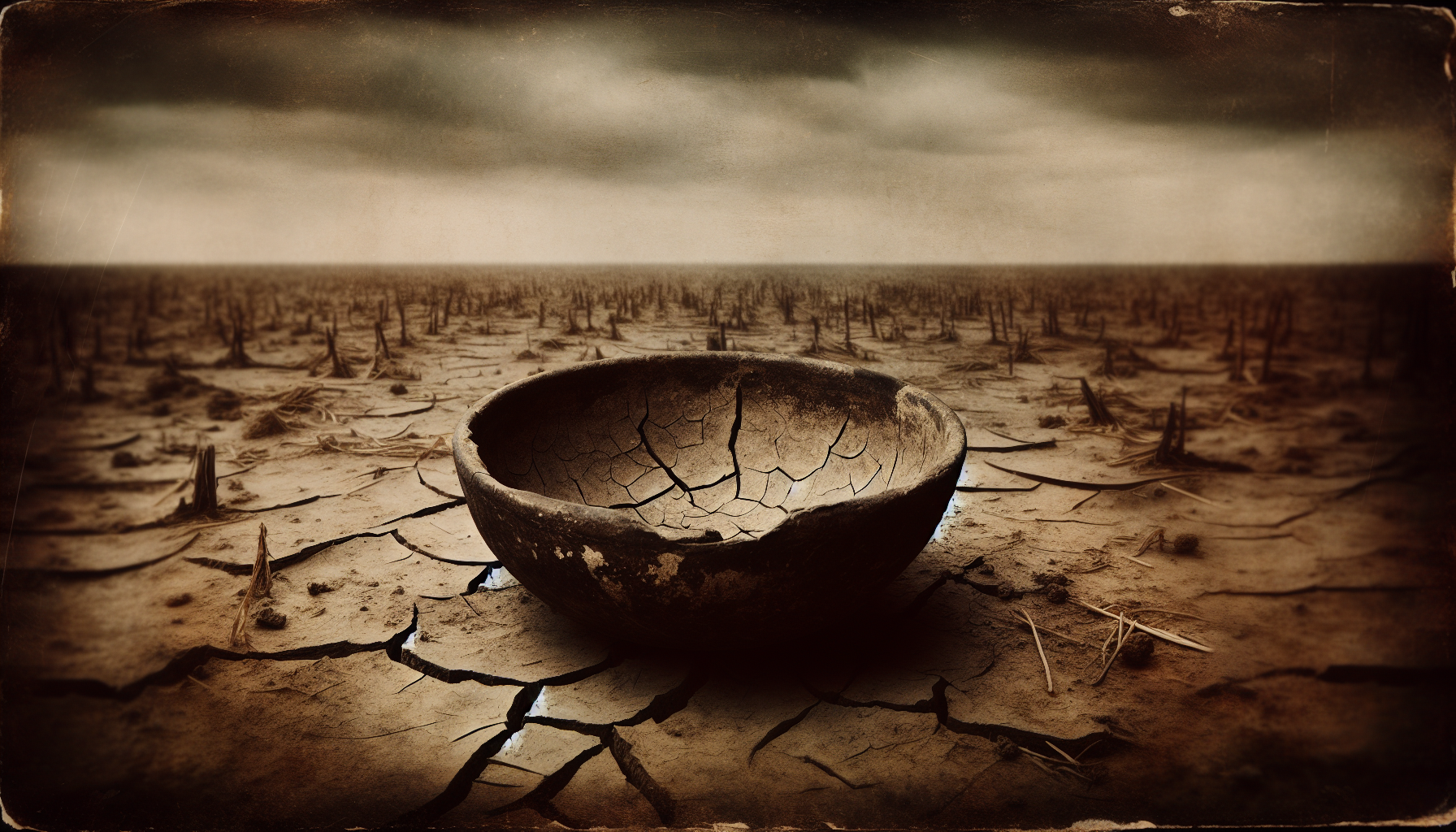
As the crisis of collectivization took hold, agricultural production in Ukraine plummeted. The disruption of farming practices led to a dramatic reduction in crop yields, especially in the context of the requisition quotas that left farmers little room for sustenance crops. Indeed, many communities, stripped of their staples and forced to submit their remaining produce to the state, faced absolute deprivation, plunged into a hunger crisis where starvation loomed threateningly.
The culmination of these factors contributed to the emergence of a famine that would claim millions of lives. Coined the Holodomor, or “death by hunger,” the disaster revealed a collective tragedy born from the intersection of oppression, neglect, and the hubris of central planning.
Humanitarian Crisis
Immediate effects on the population
As starvation tightened its grip on Ukraine, the immediate effects on the population became hauntingly clear. The swell of hunger strained the human spirit, leading to widespread suffering that attached itself to the very fabric of rural existence. The demographic toll was staggering; whole families found themselves succumbing to starvation, their fates obscured in the shadows of a regime that stood indifferent.
Death became an all-too-familiar companion within communities, with the weak disproportionately affected. The elderly, children, and those already vulnerable to illness succumbed to the aftermath of policies designed to extract resources at all costs. The social landscape altered forever, characterized by desolation and grief, as Ukraine’s humanity was systematically annihilated through state-sanctioned starvation.
Widespread starvation and malnutrition
As the famine deepened, widespread starvation spread through the population like a disease. The National Census of 1937 evidenced a startling demographic collapse, demonstrating the catastrophic consequences of enforced starvation upon the populace. Reports of malnutrition, deficiency diseases, and food-related death became commonplace, condemning millions to an excruciating fate within the increasing silence of hunger.
Survivors scavenged for whatever remnants might stave off hunger—wild plants, bark, and even grass became substitutes for sustenance as desperation took an iron grip. But the deprivation was unrelenting: many resorted to extreme measures, and desperation turned neighbor against neighbor when the specter of survival loomed largest.
Public health issues during the famine
The humanitarian crisis exerted significant strains on public health. The perilous lack of food inevitably compounded underlying health issues, leaving individuals more susceptible to diseases fueled by malnutrition. The influx of illness—typhus, dysentery, and others—further exacerbated the population’s suffering. Medical facilities, overwhelmed and under-resourced, faltered under the weight of nascent public health catastrophes.
The disintegration of community structures further fragmented access to healthcare resources. Aid organizations had their hands tied by governmental policies that prevented them from intervening to support those in dire need. The veil cast by the Soviet regime upon the ongoing disaster deprived the world of awareness and similar support, propelling the arc of suffering even deeper into the void.
International Response to the Famine
News coverage and global awareness
The reality of the famine began to emerge beyond Eastern Europe’s borders, yet the news coverage remained muted and sporadic. Western journalists and émigrés attempted to report on the tragedy unfolding in Ukraine, shedding light on the horrific conditions faced by millions. However, their articles often faced suppression and dismissal, as the Soviet government labeled them as fabrications intended to undermine the Soviet vision of modernization.
International awareness remained a double-edged sword; the stories that circulated generated outrage among some, while others pushed aside the realities, choosing instead to champion the Soviet Union as a model for social change. The retreat into ideological frameworks blurred the urgency of empathy, and as the world grappled with its crises, the mortal suffering of the Ukrainian people faded into obscurity.
Responses from foreign governments and organizations
The global response to the famine was largely marked by political expediency and existing diplomatic ties. While some policies had emerged condemning the injustices perpetuated by the Kremlin, many governments refrained from taking a firmer stance for fear of destabilizing those relationships. The famine’s impact on foreign political posturing created a dynamic where moral outrage often yielded to pragmatic silence, leaving millions in Ukraine beleaguered by a colossal struggle for survival with little international support.
While discussions ensued among dissidents and human rights advocates, most efforts to rally a unified response foundered amid competing domestic interests worldwide. Compounded with the denial and misinformation emanating from Soviet leadership, the collective indifference paralyzed action, leaving the stricken country staggering alone beneath the weight of tribal neglect.
Political ramifications and debates
The international debate surrounding the famine ignited discussions that tangled political ideologies with humanitarian emergencies. While many perceived the tragedy simply as a result of overreach in governance, others posited a systematic extermination of an ethnic population, arguing for recognition of the famine as a genocide against the Ukrainian nation. Such claims met with resistance in various global forums, complicating rhetoric surrounding post-war geopolitics.
The implications of this debate extended beyond the immediate crisis, as the canceled historical ramifications aligned with contemporary discussions of state policies and genocide recognition to create a fixed narrative that ultimately served to further entrench ideological divides across political landscapes.

Survivor Accounts and Testimonies
Personal stories of those who lived through the famine
Survivor accounts of the Holodomor form an essential component of understanding this atrocity. Each story recounts horrific events with painful clarity—a tape of desperation marked by hunger, loss, and unimaginable struggle. Individuals like Maria P., who lost her family to starvation, reflect an experience that intertwines personal grief with national tragedy, speaking to the persistence of memory amid despair.
These heartfelt testimonies encapsulate the greater human experience of the famine, conveying not merely individual struggles but shedding light on communal resilience in the direst of circumstances. The enormity of these narratives bypasses historical abstraction, anchoring the Holodomor within the lived realities of survivors and their descendants.
Oral histories and written testimonies
Preserving oral histories and written testimonies contributes critically to understanding not only the extent of the catastrophe but also the emotional tapestry woven into the memories of survivors. These testimonies elevate the historical narrative, allowing future generations to comprehend the deeply entrenched anguish that lingers as a testament to survival.
Institutions dedicated to the preservation of these narratives, alongside community-based initiatives, work tirelessly to ensure that these voices are not only heard but also ingrained in the collective Ukrainian ethos. The act of documenting these experiences fosters a sense of identity that transcends mere survival, binding communities together through shared histories.
The importance of preserving these narratives
The preservation of survivor accounts is not a mere act of remembrance; it serves to elucidate the humanity at the heart of historical discourse. In preserving these narratives, you are tasked with maintaining the flame of memory resistant to the erosion of time and oblivion.
Moreover, these accounts form an accessible means of education regarding the past, empowering those who engage with this history to recognize and combat contemporary forms of oppression, malice, and disregard for human rights. The stories of the famine linger as testimonies of resilience amid inhumanity, inviting an understanding of larger socio-political paradigms that echo through history into your conscience.
The Famine’s Legacy in Ukraine
Cultural memory and historical narrative
The legacy of the Holodomor is intricately woven into the cultural memory of Ukraine, serving as a poignant reminder of the fragility of human life in the face of systemic brutality. The famine is neither an isolated event nor a forgotten note in history; it is an integral aspect of the national conscience that permeates literature, art, and collective dialogue.
Ukraine’s historical narrative increasingly centers around the dignity of those who suffered, instigating dialogues that seek to restore agency to victims whose lives were overshadowed by state-sanctioned cruelty. The echoes of this memory illuminate the past while invoking the imperatives for present-day justice, such as the recognition of human rights.
Holodomor commemorations and memorials
Commemorative efforts, such as remembrance days and memorials, are significant expressions of respect and solidarity with victims of the Holodomor. These gestures provide a collective space for grief, reflection, and acknowledgment of loss.
Monuments and memorials, found within Ukraine and across the world, serve as a reminder of the human cost of political ideologies and the importance of preserving history as a bulwark against future atrocities. Such events act not only as expressions of grief but as calls to action against indifference, imparting lessons vital for future generations seeking to challenge oppression.
Current debates about recognition and acknowledgment
Despite advancements in historical rectification, debates concerning recognition of the Holodomor as an act of genocide persist. While Ukraine has sought international recognition of the famine as a deliberate act of extermination, political discourse remains fractured, with differing accounts of historical narratives influencing how nations reconcile their roles in the broader geopolitical landscape.
These ongoing debates reflect pre-existing tensions, particularly as some countries grapple with acknowledging the realities of the past while maintaining their political relationships with the Russian Federation. Within Ukrainian society, the conversation about recognition invokes a deeper therapeutic reflection—an assertion of international empathy that acknowledges tragedies while reaffirming the need for justice.
Holodomor in Contemporary Politics
Recognition of the Holodomor as genocide
The question of recognizing the Holodomor as genocide represents a pivotal consideration in contemporary discussions of historical memory. In the shadow of other genocides, such as the Holocaust, the Holodomor garnered attention both as a humanitarian disaster and a politically motivated campaign against the Ukrainian people, sparking significant debate over its classification.
In Ukraine, activists, scholars, and political leaders persistently assert that recognizing the Holodomor as genocide benefits an ongoing struggle for identity and sovereignty. Internationally, efforts aimed at gaining widespread acknowledgment contribute to a re-examination of historical accountability, dialogue, and reconciliation, pushing boundaries in contemporary humanitarian discourse.
Political uses of the Holodomor narrative
The narrative of the Holodomor has been intertwined with contemporary political discourse, reflecting the complex relationship between historical memory and national identity. As political leaders invoke the memories of the famine to galvanize support for various policies, instrumentalization of history can be scrutinized.
For some, the narrative becomes a rallying cry for those advocating for Ukrainian sovereignty and self-determination, while others contend that political exploitation risks diluting the very humanity of the lived experience. Engaging with the legacy of the Holodomor necessitates a balance between honoring memory and navigating the precarious corridors of political utility.
International relations and historical revisionism
The memorialization of the Holodomor cannot be separated from contemporary international relations and the tensions wrought by historical revisionism. The opposition to recognize the famine as genocide from figures within Russian leadership reflects not only a defensive posture against allegations of historical wrongdoing but also a broader contest for narrative control in shared historical terrain.
Ukraine’s continued push for acknowledgment underscores international political dynamics, emphasizing broader implications regarding the moral imperatives of historical memory while inviting scrutiny into how nations grapple with their histories. In navigating these complexities, awareness, learning, and reconciliation become central to constructing a future built upon the lessons gleaned from the past.
Conclusion
Summary of key points discussed
As you reflect on the legacy of the Holodomor, this tragic chapter in Ukrainian history unveils the interconnectedness of ideology, policy, and human suffering. From the brutal enforcement of collectivization to the subsequent grain requisitions, you can see how the actions of a regime obliterated millions of lives. A juxtaposition emerges; a society rich in cultural identity and agricultural promise found itself mired in devastation—an act of human agency orchestrating its own demise.
The horrors of the famine demand recognition, not only for the victims who endured its ravages but also in the face of the pervasive narratives that seek to obscure or deny its existence. By deconstructing the layers of neglect surrounding the famine and reaffirming the importance of survivor narratives, a moral imperative emerges: to commemorate, to educate, and to recognize the weight of history.
Impact of the Holodomor on Ukraine’s identity
The Holodomor has indelibly shaped Ukraine’s cultural and national identity. Through suffering and loss, narratives of resilience have sparked a deeper understanding of self among the Ukrainian people, binding them through a collective memory that privileges remembrance over oblivion. Each act of commemoration enhances not only the individual’s connection to national identity but also fosters the intention to ensure that history does not repeat itself.
Importance of historical memory for future generations
As the past echoes through contemporary political discourse, it is vital that you and future generations nurture an understanding of historical memory. Comprehending the lessons of the Holodomor—about oppression, vulnerability, and resilience—becomes crucial for fostering empathy, understanding, and accountability in the face of adversity.
Through this historical lens, you have the responsibility to advocate for human rights, underscore the significance of regional identities, and confront the cycles of injustice that echo across time. In doing so, you fortify the framework of compassion and recognition vital for ensuring that tragedies, such as the Holodomor, remain relevant, elucidative, and remembered.